
Our investment committee meets each month to consider updates to your portfolio.
Background
As we enter the fourth quarter of 2026, the U.S. economy continues to grow despite higher interest rates, ongoing inflation, and uncertainty around energy and trade policy. Federal Reserve comments released on October 1 noted that the economy grew at a 2.4% annualized rate in the first half of the year. Consumer spending remained steady, and businesses continued to invest, especially in artificial intelligence. These trends are helping support the economy, although higher prices and borrowing costs may create challenges for consumers and businesses in the coming quarters.
Inflation remains above the Federal Reserve’s 2% goal; therefore, the Federal Reserve continues to take a cautious approach. It raised its key interest rate by 0.25% in September and said future decisions will depend on new economic data and changes in inflation and employment. This suggests interest rates may stay higher for longer than the markets had previously anticipated.
The job market continues to support the economy. Layoffs remain low and employers are still adding jobs, although hiring has slowed throughout this year. A gradual slowdown in hiring could help reduce inflation without causing a sharp economic decline, but the effects may differ by industry and income level. We continue to watch employment, wage growth, and consumer spending for signs that the economy can keep growing as the Federal Reserve attempts to move inflation closer to their goal.
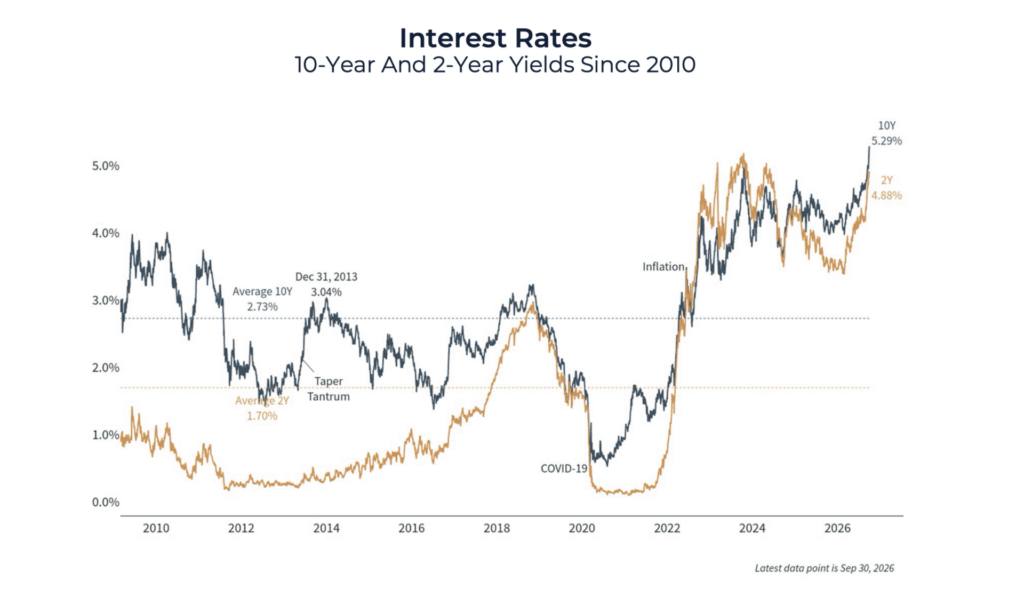
Long-term interest rates and energy prices have become more important market risks. The 10-year U.S. Treasury yield reached 5.30% in September, while the 30-year yield reached 5.64%, levels not seen in decades (see chart below). Kitces/Clearnomics notes that the rise in yields has been driven not only by inflation, but also by stronger real yields reflecting economic growth and AI-related capital investment. Higher rates can put pressure on stock valuations because investors may be less willing to pay high multiples for riskier assets when government bonds offer more attractive yields. As highlighted by The Wall Street Journal, stock prices can still advance if earnings growth is strong enough to offset valuation pressure, but the hurdle for future gains becomes higher as interest rates rise.
Overall, we expect the economy to continue growing at a modest pace over the next 12–18 months. Consumer spending, business investment, and spending on AI infrastructure may continue to provide support. However, the investment environment remains mixed, and we would not be surprised to see market weakness along the way. Our outlook remains moderately positive, but elevated valuations, higher interest rates, and continued inflation uncertainty reinforce the importance of maintaining cautious expectations over the next one to two years.
Investment Positioning (as suitable)
Stocks
We continue to view diversification across regions, sectors, market capitalizations, and investment styles as important. Higher interest rates can weigh on stock valuations, particularly for companies whose prices depend heavily on expectations for future growth. At the same time, strong and broad-based earnings growth can help offset that pressure. International exposure may provide access to different economic and valuation opportunities, though currency movements and geopolitical developments can affect results.
Overall, we are maintaining a neutral position in stocks. In recent years, we have adjusted stock allocations above or below their long-term targets, as suitable, based on our market outlook. In 2024 and 2025, we favored a modestly higher allocation to stocks to benefit from a supportive economic environment. Last year, we returned stock allocations to their long-term targets as market valuations increased. We are not currently ready to go below target allocations, but we continue to monitor market and economic conditions closely.
Bonds
Bond yields remain elevated, providing meaningful income opportunities across high-quality fixed income. Although rising yields can create near-term price pressure, today’s higher starting yields may improve future income potential and provide more room for bond prices to rise if yields later decline during an economic slowdown.
As suitable, we expect high-quality U.S. bonds, international bonds, and bond alternatives to continue serving as a source of income, portfolio stability, and diversification. We remain selective in areas where additional credit or interest-rate risk may not be adequately compensated.
Footnotes: This document was prepared with the assistance of artificial intelligence. All facts were confirmed through additional research.
Important Notice and Disclosure: The foregoing content reflects the opinions of Laurel Wealth Planning LLC and is subject to change at any time without notice. Content provided herein has been obtained from sources considered reliable, but we do not guarantee the accuracy, or the completeness of any description of securities, markets, or developments mentioned. The content is for informational purposes only and should not be used or construed as investment advice or a recommendation regarding the purchase or sale of any security. There is no guarantee that the statements, opinions, or forecasts provided herein will prove to be correct. Past performance may not be indicative of future results. LWP is a wealth management firm and does not practice law or accountancy.
Indices are not available for direct investment. Any investor who attempts to mimic the performance of an index would incur fees and expenses which would reduce returns. Securities investing involves risk, including the potential for loss of principal. There is no assurance that any investment plan or strategy will be successful.
International investments carry special risks such as currency, societal, reporting, etc. Bonds can increase or decrease with changes in interest rate or quality.


